
Albany to Tasmania - Day 7 ‘What do you do all day?’
- morganflower
- 1 day ago
- 5 min read
ANZAC Day
Saturday, April 25th 2026

After an uneventful night, we woke to find emigre on course and making reasonable time. So far this voyage has been relatively slow paced. That’s fine by me. We are in no race and have no deadline to meet. As long as we are moving at about three knots and the tiller pilot can steer a straight course, I’m happy.
Our average speed for the trip has remained at 4.7knots despite three days of wind mostly below a force four. Emigre has been fully provisioned; loaded with additional fuel, life raft, water and equipment. I suspect she would have weighed in at over eight tonnes when we departed. Her once excessively high waterline was starting to look like it needed raising again.
The result of all this extra weight is a significant reduction in performance, particularly in light winds. Combine the additional weight with a very conservative sail plan and a wind-vane that doesn’t always steer a straight course and you find your average speed isn’t what it used to be.
Speed is an important factor for safety at sea, allowing you to outrun weather systems or simply give yourself more distance from the eye of a storm. On the flip side, pushing a boat hard on a long passage significantly increases the loads on the rigging, mast, hull, sails, steering system and most importantly the crew.
Jon Sanders constantly reiterates that when cruising offshore, you should reduce the load on your boat and equipment as much as possible to ensure you get there safely. After completing a 768 day solo, non-stop, triple circumnavigation of the world, I think he may have a point.
When discussing tactics for the voyage recently, he mentioned that during his 11th solo circumnavigation, he never had to remove his main or headsail from the boat or make any repairs to them whatsoever. Not only is that a credit to his sailmaker Rolly Tasker Sails, but to the conservative way he sailed almost 25,000 nautical miles around the world without incident. Sometimes less is more.
Emigre’s mainsail is over twenty years old and made from Dacron. It’s been heavily used and abused by me with many coastal trips between Fremantle and Albany. Despite its age, regular maintenance from Carl at Extreme Sails has ensured it’s still in reasonable condition.
I find that keeping the boom relatively stationary using a preventer helps to reduce wear and tear on the sail on long voyages. A preventer is a line that is rigged from the outboard end of the boom, forward to a block located at a strong point somewhere towards the bow, and run back to the cockpit where it can be made fast to a rope clutch or cleat.
In Emigre’s case, particularly when reaching or sailing downwind, I ease the mainsheet until the sail is slightly under sheeted, hand tension and make fast the preventer before tensioning the boom with the main sheet. This not only stops the boom from accidentally gybing but also acts as a kind of boom vang or boom downhaul when the main is reefed.
The headsail is a ‘hand me down’ from Jon’s Perie Banou II. Originally a number two, it’s made from heavy duty 9 oz Dacron and was cut down to a number three size to suit Emigre by Carl at Extreme Sails. Paired with a Profurler headsail furling system, it is easy to reef down when the wind picks up.
Like most days at sea, the morning started with eggs on toast for breakfast and a coffee for Kevin. It’s always a challenge getting four fried eggs into a small frypan rocking about on a gimballed stove in a following sea. Typically it turns into one big egg with four broken yokes. Tastes the same none the less. Being old and full of primitive technology, Emigre has a traditional two burner gas stove and oven. Apart from being rusty from years of leaking windows, it works well and most importantly has a sturdy gimbal and pot rack surrounding the two burners. Equipped with the appropriate gas leak detection system and solenoid at the bottle, it has always provided a safe and reliable means of cooking.
Kevin tells me that cooking on board a sailboat is much easier and safer with modern technology such as microwaves, air fryers, toasters, kettles and even coffee machines?? That’s all well and good in a 52ft small ship complete with a 15KW generator that is bigger than emigre’s main engine.
Emigre has a modest lithium battery bank, solar array and refrigeration unfortunately leaving me short of capacity to run an inverter. The limited power that the sun or the small alternator on the engine creates has to be prioritised for navigation, communications and refrigeration. Perhaps my next boat will have room for all the mod cons. For now, the gas system remains.
Breakfast conveniently falls during the Austravel Safetynet HF sked time, requiring some juggling to cook, eat and operate the radio at the same time. Better planning on my part could alleviate this problem.
We spent the day taking it easy, monitoring our course, checking the weather, eating, sleeping and watching downloaded YouTube videos.
Between all this hard work, sailed have to be attended to, the Aries Windvane needs to be oiled daily and lines need to be monitored for chafe.
A couple of days ago when sitting out in the cockpit, we noticed one of the bolts for the support for Emigre’s solar arch and bimini had snapped. It was very rusted, clearly not 316 grade stainless steel. Part of Emigre’s weight problem come from the vast stores of tools, chemicals, oils, spares, and accessories that I carry to be equipped to undertake minor repairs when at sea such as this.
I retrieved my tool belt from the starboard saloon locker that contained a hammer and punch. Upon doing so, I found that my bottle of 75w90 gear oil for use in the leg of the outboard engine had tipped over and spilt all through the locker. A five minute bolt replacement turned into a hour of removing tools, wiping the clean of oil, cleaning the inside of the locker and re-stacking them. I guess my tools won’t rust now ??
With the oil cleaned up, we removed the two rusty halves of the broken bolt and began hunting through the bag of bolts I keep stowed for situations such as this one. With an appropriate bolt, mudguard washer and Nyloc nut acquired, the solar frame was once again secured to the cockpit combing.
Dinner consisted of lentil soup polished off with some of tasmania’s ‘finest’ Cadbury chocolate.
About midnight we were woken by the screeching of the VHF radio. I immediately turned to the handset in my bunk to check the alarm. It was an AIS (Automatic Identification System) alarm for an oncoming vessel. Upon inspection of the chart-plotter, we had a 225m, Singaporean registered cargo ship ‘Mario’ heading toward us on a collision course.
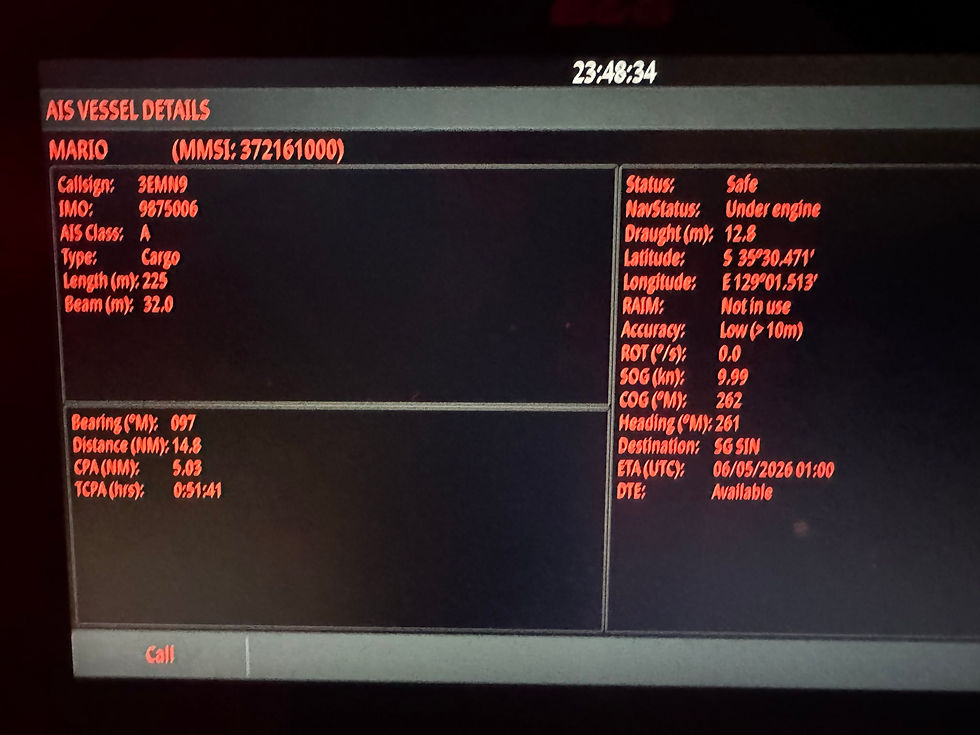
Thankfully the alarm had alerted us whilst it was still 18 nautical miles away. I adjusted our course to increase our closest point of approach.
To confirm that the ship had seen us, I called on the VHF Radio and made my intentions clear to the watch keeper. After confirming he could see our position and telling us to maintain our course, we stayed up for the next hour until we could see the faint lights of the ‘Mario’ pass on our starboard side.

On a final note, thank you to all our veterans and current members of our armed forces. Without your sacrifice, Australia wouldn’t be the free country it is today. Lest we forget.
Also, wishing grandma a very happy 95th birthday today.


Comments