
Albany to Tasmania - Day 5 Settling Into Life at Sea
- morganflower
- 11 hours ago
- 3 min read
Thursday, April 23rd 2026.

Today was relatively uneventful. After retrieving and securing the anchor, I turned my attention to our course. The wind had backed from North East to North West. We were sailing on a broad reach with a wind angle of approximately 160°. Our course over ground was closer to 70°M.
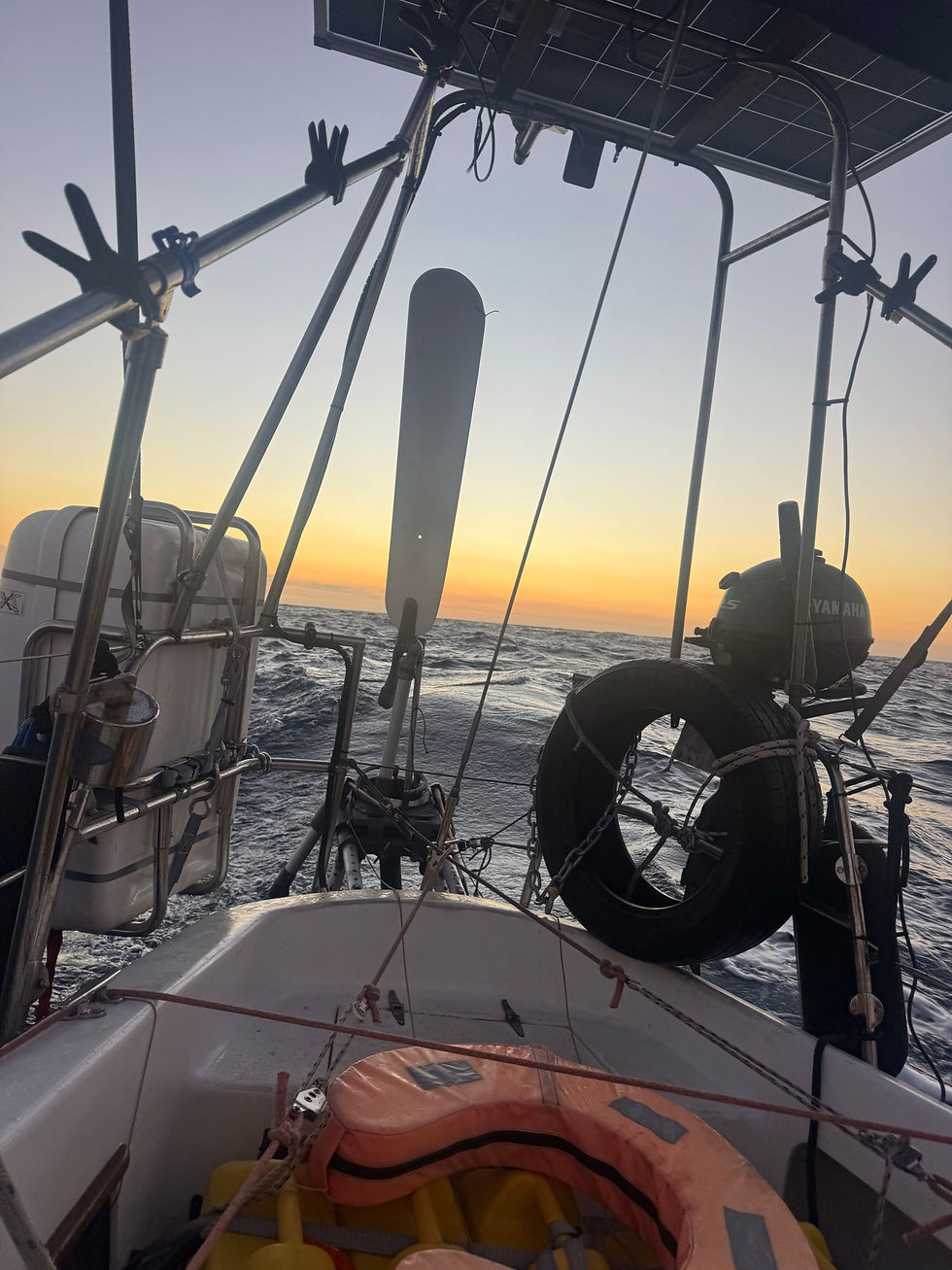
I decided to rig the spinnaker pole on the Port side to pole out the jib. It’s only a number three that doesn’t overlap the mast and sets flat as a board when poled out.
I went forward and rigged the preventer line through the a block on the foredeck, leading it outside the starboard shrouds and attaching it to the end of the boom. With the preventer tensioned and pinning the boom out near the lower shrouds, the boom is prevented from violently swinging from one side to another in the case of an accidental gybe. I think it’s always a good idea to rig a preventer when sailing directly downwind to reduce the chance of damage to the boat or crew if the boat gybes accidentally.
With the main secured, I went forward and attached the topping lift to the spinnaker pole, clipped the jib sheet into the beak and then clipped the inboard end of the pole to the mast.
Using the topping lift, I hoisted the pole to sit level with the boom and parallel to the water. On the way back to the cockpit, I released the pin stop from the jib car and slid it aft so the jib sheet had a better lead angle to the end of the spinnaker pole.
From the cockpit I was able to unfurl the jib two thirds and set the wind vane to a 180° wind angle or directly downwind.
This improved our course for a few hours before the wind swung to the South West and we were once again heading North East. Before sunset, I went forward and gybed the spinnaker pole, unfurling the jib on the Starboard side and setting the main on the Port side. We travelled like this heading ESE into the evening until the wind dropped completely.
We furled the jib and centred the main. I look opened the inlet and two exhaust valves for the auxiliary engine. After coercing a sticky starter, the Kubota engine sprung to life.
Ghosting along at 1750rpm, I calculated my fuel consumption was around 1.6 litres per hour. With 230L on board that’s nearly six days of motoring range at 4-5knots. Ideal.
After a hearty meal of vegetable pie heated in the gimballed oven, we made the most of the quiet conditions and got some sleep.
In the early hours of the morning, I noticed a large bulk carrier on AIS, approximately 36 nm east of us. I kept a close eye on his CPA (Closest point of approach) and TTCPA (Time to closest point of approach) from my bunk using the wireless VHF remote.
It allows me to set a CPA and TTCPA alarm that would wake me if any vessel broadcasting AIS came within a certain radius.
As the ship drew closer, I decided to send him a routine DSC (Digital Selective Calling) call to inform him that I was tracking his course and could alter my course if required.
Digital Selective Calling is a feature in modern marine VHF Radios that allows a single radio to be alerted, much like a phone call.
DSC capable marine VHF radios are programmed with a Maritime Mobile Service Identification number (MMSI) which is essentially the radio’s phone number.
When connected to a GPS receivers DSC can be used by the radio in an emergency to send an automated message to all ships and shore stations within range, detailing the ship’s name, call sign, position, speed, heading and nature of its emergency.
The ship’s radio operator acknowledged my call and advised me to continue on my existing course.
By morning the wind was still light and variable. We cooked eggs on toast for breakfast and did some housekeeping before I switched the HF on for the morning Austravel Sked. Sked operator Warren reported a good signal into the Penong (SA) base and Busselton (WA) base.
Time to start thinking about lunch I guess? The struggles of life at sea…


Great description. Nice to tag along with the blog. Thanks Morgan and Morgan buddy.