
Albany to Tasmania - Day 19‘The Final Leg - To Kettering Via The Denison Canal’
Tuesday, May 20th 2026.
Sunrise at Chinaman’s Bay is sight to behold. Encapsulated within a keyhole bay, surrounded by mountains and hills, we woke up to flat calm glassy water and views that looked like an oil painting. Stepping outside in the cockpit, I got a whiff of that fresh crisp Tasmanian air. The decks were covered in dew making it slippery as I walked forward to take some photos from the foredeck.
I put the kettle on to make a morning brew and fried up a few eggs for breakfast. We had a few jobs to complete before hauling anchor including pressing up the main fuel tank and lifting the Aries Wind Vane clear of the water. It wouldn’t be required for the last leg of the voyage. I tipped two jerry cans into the tank. That’s about forty litres we had used in the last 24hrs of motoring from the North East Cape down the East coast of Tasmania. Not bad. We weren’t in a rush as we had to wait for the tide to rise for the next leg of our voyage through the Marion Narrows and Denison Canal.
We weighed anchor at about 0830hrs and motored out of Chinaman’s Bay into the Mercury Passage. The wind was very light, around a force two. We had approximately seven nautical miles to run to get to our next navigational challenge; the Marion Narrows.

The narrows are the entrance to Blackman Bay, a large body of water protected by a sand bar on the South East coast of Tasmania. By crossing the sand bar, vessels can transit the shallow narrows and access Blackman Bay and the town of Dunalley. Dunalley is a quiet fishing village located on the road between Hobart and Port Arthur. Vehicles travelling to Port Arthur not only pass by Dunalley, but must drive over the Denison Canal which connect Blackman Bay to Dunalley Bay. Vehicles drive across a swing bridge that is opened on request for vessels to transit. By transiting the canal, vessels travel approximately 45 nautical miles less than rounding the south east cape on the way to Hobart. Thats’s approximately nine hours of sailing in rough water that I was quite happy to do without.
Although it wasn’t my first transit, entering the narrows was slightly terrifying as we had waves breaking abeam of us when crossing the bar. I typically try to stay well away from surf breaks but apparently not this time as a surfer paddled past our starboard beam.

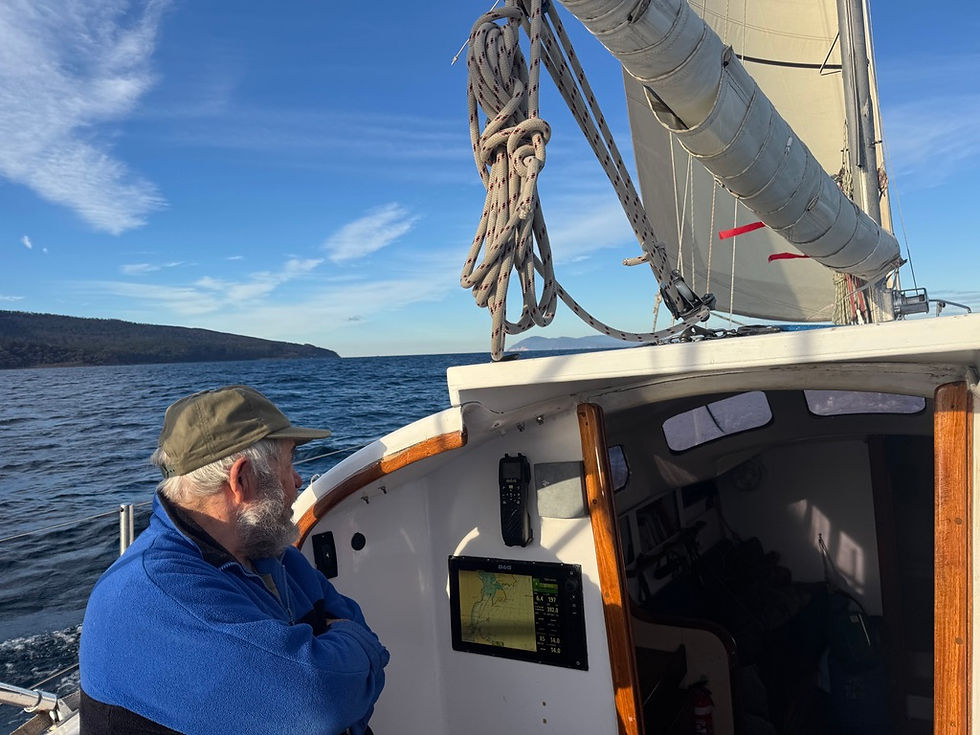
I had downloaded a GPX track file that is provided by Marine and Safety Tasmania (MAST) and loaded it into the chart plotter so that we had a known route to follow. The Denison Canal Superintendent was very helpful ensuring me that we would have enough water under the keel despite our six foot draught. We safely transited the bar and worked our way around the slalom of channel markers leading up to Blackman Bay. From the bar, it’s about a seven nautical mile steam up to the town of Dunalley and the entrance to the Denison Canal. Having pre arranged our transit, we motored straight past Dunalley and into the canal. Kevin steered Emigre, pushing against the flooding tide. I recorded the moment we passed the swing bridge from the foredeck. By 1145hrs, we were through.
Kevin set the tiller pilot to steer us out of Norfolk Bay and towards Betsy Island and the Iron Pot. It was approximately thirty five nautical miles from the Denison Canal to Kettering. I raised the mainsail in hope that the wind would veer allowing us to sail for a some of that distance. The wind had other ideas.

You can guarantee two things when you are getting close to the end of a long voyage. Time slows down and the conditions will never be favourable. Emigre’s engine worked hard pushing us towards Dennes Point into a head wind. With the promise of cold beers and hot showers waiting for us at the Kettering public jetty, we pushed hard to beat the sunset for our arrival.

Rounding Dennes Point, we began to fight the ebbing tide running out of the D’Entrecasteaux Channel further slowing our progress. With the little engine’s rpm only limited by the throttle lever touching the bulkhead, we clawed our way up the channel and into Little Oyster Cove. The light was fading as we approached the Kettering Jetty where our friend Scott was waiting to catch our lines.

That first sip of beer from Scott’s own ‘Hobart Brewing Company’ sealed the deal. We had arrived.

Kevin and I shut down the engine and sat down in the cabin, contemplating our accomplishment. We had sailed 1723 nautical miles together without incident, injury or mutiny. Emigre had sailed 2230 nautical miles from Quindalup without any major breakage or incident, other than an engine full of water.
We quickly polished off a couple more beers each before we walked up to Kate and Scott’s place over the road for a shower and dinner. It felt great being clean, warm and dry again. Scott had the fire roaring and made us a delicious meal. We sat around and talked about the voyage and Kevin’s colourful career as a doctor in the Royal Australian Navy and in Antarctica. Scott’s latest brew just for our arrival; “You Bet You Lose” was flowing nicely off the tap.

It’s been a busy time since arriving in Kettering; arranging a mooring, picking up my car and trailer, launching my dinghy and getting settled into life here. I’ve been busy following up work leads and quoting marine electrical jobs. Around all that I’ve managed to find some time to socialise and get involved with other boat shenanigans such as taking a nearly 100 year old Tamar Couta Boat out of the water and taking it off a trailer in preparation for repair and antifouling.

This trip to Tasmania has been a long time in the making. I have spent the last two winters here on the land with each visit giving me more encouragement to bring the boat here and live for a while. My close friends and family have heard all about it for the last twelve months. I left Tasmania last July and had hoped to leave Fremantle in Emigre in September to cross the Bight in October. Emigre didn’t get hauled out in Albany until January 19th and didn’t splash again until March 30th. Her voyage to Tasmania didn’t begin until April 9th.
Even after James and I had departed Albany with the boat as prepared as we could possibly make her, we had to divert to Esperance for repairs. I have learnt first hand that planning a long voyage in an old boat takes a whole lot of two things; money and patience. Both these things I have very little of.
The trip would never have happened if my family and friends didn’t entertain my idea to sail Emigre to Tasmania. Emigre’s refit project required a huge amount of work, and plenty of expertise that I was lacking. I will hopefully write more about the refit in the future but it wouldn’t have been possible without the following people and businesses. This is not an ad but it should be. Emigre wouldn’t have left WA without them:
John and Roger from Yacht Grot sourced and supplied almost everything thing required to get Emigre ready to go offshore including safety equipment, fastenings, sealants, paint, antifouling, chemicals, electronics, electrical parts, plumbing supplies, rope, rigging, foul weather gear, and excellent advice. These guys along with their team are not just retailers, or employers but great friends and supporters of this trip.
Captain Steve gave me hours and hours of work aboard his catamaran, provided infinite wisdom about navigation, weather and planning the voyage as well as crewing for me from Fremantle to Quindalup.
Brad from Sealed Fabrication is a first class fabricator who repaired Emigre’s mast and fitted a new winch base for the main halyard winch. He also fitted my new deckhouse windows which never leaked a drop.
Brian, the self appointed mayor of Fremantle Sailing Club, has been helping out from the beginning. From bailing the rain water out of a slowly sinking Emigre when I was in Tasmania last winter to travelling to Albany to help with the final stages of the refit, Brian has been there out at every stage.
Northy from Trimtronics repaired and modified my aging bunk cushion at very short notice, giving the crew a somewhat comfortable place to sleep.
Super Chris from LMH Repairs saved the day on our way to Esperance. He talked me through getting the water out of the Kubota Engine and had us up and running again in no time.
Wade from Renewables Esperance managed to remove our seised injector line and get the Engine’s fuel system working again.
Jon Sanders continues to be my ever reliable source of knowledge for passage planning, weather routing and encouragement.
I must make special mention of a few individuals who really went above and beyond to make this trip happen:
Mike allowed me to stay free of charge in his incredible self contained studio apartment for nearly two months whilst in Albany working on Emigre. Without this extremely generous offer I would likely have been camping in a swag under a fibreglass dust filled boat. Being able to go home to a warm dry apartment with cooking facilities and a hot shower not only saved me a small fortune but allowed me to keep the momentum up with the refit. Sincere thank to you Mike.
Darren from Emu Point Shipwrights has been instrumental in Emigre’s refit. Having worked on Emigre in the past, I knew Darren’s work is excellent and Emu Point Slipway would be the ideal location to get the significant structural repairs completed prior to crossing the bight. Darren assisted with the planning and execution of this work from removing the rig and lifting the boat to personally undertaking most of the structural work himself with assistance from his apprentice Josh and offsider Tom. Darren was extremely patient and taught me lots of new skills including how to fabricate and bend stainless steel chain plates and complete a range of fibreglass repairs. I will explain more about the work completed in a future blog but it included removing most of the saloon cabinetry, removing all of the hanging knees, installing two structural stringers a third of the length of the hull, replacing and doubling rotten sections of the main bulkhead, replacing the hanging knees and chainplates and rebuilding the interior. Plus significant repair to the keel and rudder.
During the voyage Emigre endured force eight to nine headwinds that punished the rig and chainplates. I had 100% confidence in Darren’s structural repairs and improvements which allowed Emigre to make it to Tasmania without incident. Absolutely couldn’t have done it without you. Thank you Darren.
With life getting in the way you probably won’t be reading much here for the time being. When i’m at sea, I have plenty of time to write but that time evaporates fast when in port. I’d like to thank everyone who has read these completely unedited, unfiltered and mostly technical blogs. Selfishly I write these for myself to remember my trips and projects as times goes by. I never expected that anyone else might find them interesting.
Until the next voyage, Hold Fast.


Comments