
Albany to Tasmania - Day 17 ‘Engine Checks Save Engines’
- morganflower
- 4 minutes ago
- 5 min read
Sunday, May 17th 2026.

I woke up around 09:30-10:00hrs after catching a few hours sleep. My usual routine when waking up is to first check our course and position on the chartplotter or using the Navionics app on my phone. I then open the Victron connect app and figure out the state of charge of my batteries. This is relatively simple to do with a basic voltmeter when you have lead acid / AGM batteries as you can somewhat accurately predict the state of charge based on the voltage.
It becomes more difficult with lithium iron phosphate chemistry such as Emigre’s house batteries. Lithium batteries maintain a relatively constant voltage from 99% state of charge down to about 15%. The best way to accurately measure the state of charge of a lithium battery is by using a device called a shunt.
A shunt is like a ticket counter standing outside a festival or event. Instead of counting the people coming and going from the event, a shunt counts the amount of electricity coming and going from a battery bank. By programming the shunt with the capacity of the battery bank and synchronising it when the batteries bank is fully charged, the shunt will continually count the amount of amps going in or out of battery and display the ‘level’ as the number of ‘amp hours’, or as a percentage state of charge.
It’s pretty easy to understand state of charge as a percentage. Your phone, laptop, power bank, etc, usually display a battery percentage in this way. All these devices use a tiny shunt to make this calculation.
Understanding the correlation between amps (amperes) and amp hours (ampere hours) makes the world of DC electrical make much more sense.
I like to think of a battery like a water tank. If your water tank holds 100 litres and you are using 1 litre per hour, your tap would run for 100 hours.
The same logic applies to batteries. A relatively common deep cycle battery size in a boat or caravan is around 100 amp hours. Technically speaking, that battery could power a light globe that consumed 1 amp of electricity for 100 hours.
In reality, you can damage a battery if you discharge it completely. A general rule of thumb for lead acid or AGM batteries is to never discharge them more than 50% of their rated capacity in amp hours. I.E, the useable capacity of a 100ah lead acid battery is approximately 50ah.
With lithium batteries, we can discharge the batteries to around 80% depth of discharge meaning that the battery has just 20% of its original capacity remaining. This makes lithium batteries much more ‘energy dense’ meaning that you can fit more energy (amp hours) into a smaller and lighter footprint.
Okay enough explaining… Long story short, I don’t have a shunt fitted to Emigre’s house battery bank so it makes figuring out the state of charge more difficult. From some rough calculations, I estimated we had drained the house batteries down to about 15% state of charge. That’s lower than I would like.

The only thing to do was to start the engine again.
We motor sailed for the next hour in about 12 knots of wind until the wind died completely as forecast.
The seas were flat calm in Bass Strait. That’s not something I thought I would be writing. 8/8 cloud covered the sky as we approached Banks Strait, the eight nautical mile wide passage between the North East Cape of Tasmania and Clarke Island.
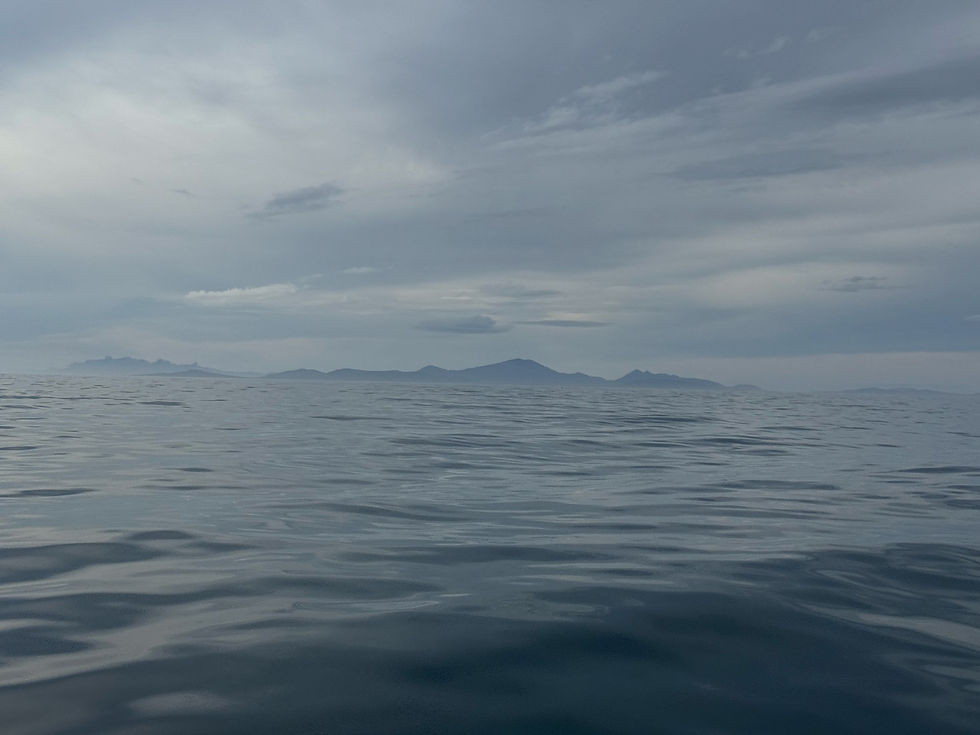
We timed the tide perfectly as it ebbed in our favour as we approached. Emigre motors in flat water at about five knots, in the strait we were making between eight and nine knots with a following current.

This was the first sight of land since leaving Kangaroo Island four days prior. The steep mountains of the Ferneaux group on our port beam were contrasted by the relatively flat North East Cape of Tasmania to our Starboard. A farm of wind turbines sat still on the cape.
The sun was setting as we cleared Banks Strait, now punching into steep swells from North East and South East. We turned to starboard and began to run down the Tasmanian East Coast as night fell.

About 23:30, I decided to take a look in the engine compartment to check for any leaks or other problems. I noticed the alternator V belt was extremely loose and rubbing against a hose clamp. It was only a matter of time before it would have broken and the engine would have overheated.

I shut down the engine and got out my socket set to begin removing the old belt. I carry about four spares on board so finding a replacement wasn’t difficult.
Kevin held the engine box and socket set to stop it flying across the cabin as I loosened the tensioner bolts. The alternator slid towards the engine and the damaged belt was easily removed. The front of the engine was covered in belt dust that had been removed from the belt by the hose clamp it was rubbing on.

I cleaned the engine and alternator with paper towels before fitting and tightening the new belt.
Before starting the engine again, I dipped the oil to check the level and then opened the sea strainer basket to check for weed. The basket had been improperly fitted (by me) and had weed restricting the inlet significantly. After removing the basket, cleaning the debris and refitting it correctly, I bled the air out of the strainer by leaving the lid loose and opening the seawater inlet valve.
Once the strainer was full of water, I tightened the lid so it didn’t leak.

I noticed the starboard aft engine mount had come loose. The engine mount is made from rubber with a steel stud protruding on which the engine is affixed.
A bracket from the side of the engine is clamped in position on the mount between two nuts. Due to the vibration of the engine over time and the absence of lock tight or lock washers, the nuts had managed to work themselves loose.
I tightened the nuts to the original alignment position as indicated by the rust on the thread of the engine mount. This is absolutely not how an engine should be aligned but I figured being attached to four engine mounts must be better than three. I will re align the engine once I get to Kettering.
With that taken care of, I started the engine and we continued making steady progress for the remainder of the night, only encountering one fishing vessel that was not on AIS.
Stay tuned tomorrow for the last 100 nautical miles as we head towards Maria Island and the Marion Narrows.


Comments